Bermuda’s MPs tonight finally passed the amendment to the Human Rights Act making it illegal to discriminate against someone because of their sexual orientation.  [They also voted to ban age discrimination … although oddly not in the workplace.] The bill will now pass to the Senate next week for debate. An amendment by the PLP MP Wayne Furbert to specifically prohibit gay marriage was defeated.

It took nine (yes, NINE) hours of often self-righteous grandstanding in the House of Assembly before the amendment was passed. OBA Sylvan Richards said it best: ““It’s kind of absurd to me that we’re even having this discussion. The God I serve says we are to love one another.”

Some of the statements were so absurd they were outright laughable. Like this, from PLP Leader Marc Bean, who should surely know better: “It is my position is that sexual orientation is not a basic human right. It’s orientation to something that already exists. One’s orientation can change.”

Thankfully others, like Attorney General Mark Pettingill (OBA) offered some much-needed perspective: “People are born gay. They don’t wake up one day and turn gay.”

At the end of the day, though, it was a sign of political and social maturity that the issue got debated at all, even if the level of debate was barely above that of some of the social media “discussions” online. In 2006, the House fell silent when PLP MP Renee Webb tried to table the amendment.

The Royal Gazette quoted a spokesperson from lobby group Two Words And A Comma as saying: This is a significant day for human rights in Bermuda. We are encouraged by the debate, though this amendment is long overdue. It looks like Bermuda’s closely-held belief that discrimination is unacceptable will soon be enshrined more fully in our human rights law.”

Incidentally, I’d like to make a point of thanking all those reporters and commentators who worked their tails off today keeping everybody up to speed with events (and supplying the quotes I used above). We’re beginning to take this stuff for granted but today I was able to follow everything live on The Royal Gazette and Bermuda Sun websites and social media sites, on Bernews, via the live audio stream on the Government site, and even Bermemes. That sort of rolling coverage would have been unthinkable in Bermuda even five years ago.

Yes, there was a lot of rubbish spouted on Facebook, Twitter, etc. as there always is but on balance, it enables a level of public engagement, free speech and frank, open discussion that, again, would not have been possible a few years ago. That can only be a good thing.

I don’t often find myself agreeing with Walter Roban (PLP) but as he stated: “It’s been a good day for the principles of freedom and democracy.”


UPDATE (June 20): The amendment was passed in the Senate.

Judging from the many comments, phone calls, emails and texts I’ve had about my recent post on editorial independence, a lot of people share my concerns. Today’s Royal Gazette is another reason to be concerned.

RG-wrap

Here’s the news … but first a really annoying word from our sponsor.

It features what the industry calls a “wrap” – advertising that masks part or all of the front page. The Gazette certainly isn’t the first paper to do this and it won’t, sadly, be the last. Wraps, which are lucrative revenue earners for cash-strapped newspapers, are controversially creeping across many of the world’s newspapers.

The Daily Express in the UK took a lot of flak in 2009 when it obscured coverage of Barack Obama’s historic inauguration with a four-page wrap marking the first birthday of the Fiat 500. Ditto The Guardian, when it carried its first wrap last year for a phone company. In 2010, an appalling wrap for the Johnny Depp film Alice In Wonderland mimicked the front page of the LA Times.

Newspapers seem to be returning to the 18th and 19th century, when the front pages of many leading publications were completely full of ads. As journalism and professional reporting became more established, news content grew and became the main driver of circulation. The front page became sacrosanct and defended by editors and owners alike against front-page ads of any kind.

LA Times: re-defining the front page "mock up".

LA Times: re-defining the term “front page mock up”.

A few years ago, Gene Roberts, a former managing editor of the New York Times and executive editor of the Philadelphia Inquirer, told the American Journalism Review that front-page ads were another in a series of industry mistakes triggered by short-term thinking. “It’s one more in this kind of death by a thousand cuts that the newspaper business seems to be administering to itself. In the long run, the big necessity is to get and maintain readers, and I think without question that front-page ads work against readership.”

Every advertiser naturally wants to be on the front page because it’s the most-read page in a newspaper. Although my company plans and produces advertising, I never recommend wraparounds and dissuade clients from doing so. Why? Because I believe they are counter-productive and not worth the premium rates that media organisations charge. Journalists and editors naturally hate them and readers generally resent them in the same way they resent ads that often pop-up when you load a web page. I’m sure I’m not the only reader who immediately rips off the wrap and chucks it in the nearest trash bin.

I’m not sure if today’s half-page wrap is a first for the Gazette but we’ll be seeing more and you just know that a full page wrap won’t be far behind.

I hope that the Gazette resists this trend and is able to find an alternative revenue stream for many of the same reasons that I stated the other day. When advertising becomes the front page, it tells readers that the news is not important. It devalues the very reason that newspapers exist for in the first place and further blurs the line between news and business interests.

Wraps are part of a slippery slope that turns a newspaper into an advertising free-sheet. And if newspaper owners and advertisers risk alienating the very people they are trying to attract, then what’s the point?

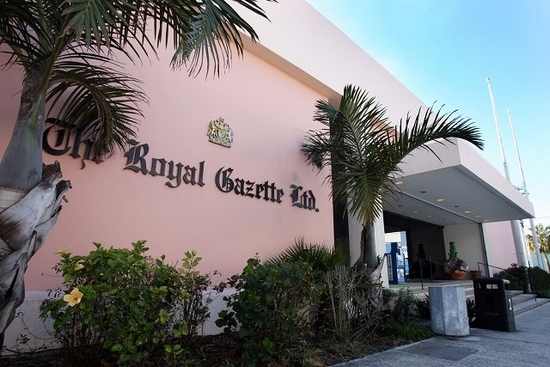
RGLtdWhat on earth is going on at The Royal Gazette these days?

Over the past weeks there has been a rash of unusually soft front page lead stories that would have normally run on feature pages at best while more important news articles were carried – some would say buried – on inside pages. Last week this reached a nadir when the front-page lead stories included:

These stories certainly have a place in the paper. They are worthwhile community stories but they have no place being the lead story itself.

So what’s going on here? Have acting editor Jeremy Deacon’s news senses deserted him or, as PLP leader Marc Bean claimed recently, have Gazette journalists “been told by their editors, and their board of directors, that nothing negative about the OBA Government, or Bermuda in general, can be on the front page, let alone reported on”?

Jonathan Howes, the Gazette CEO, angrily denied this and threatened to sue Mr. Bean, prompting one reader to write this week: “We expect [the Gazette] to hold every organ of this Government accountable. As uncomfortable as it may make Mr. Howes and the board, the evidence of bias is clear; deliberate or not.”

Mr. Bean and the letter writer may be a little wide of the mark politically – ‘Jetgate’ has had plenty of coverage in the Gazette, for example – but it is my understanding that the board of the Bermuda Press (owners of The Royal Gazette), through its publishing committee, has indeed been putting increasing pressure on the editorial department to run more “positive” stories on the front page, and wants closer control over editorial content and direction. I understand that none of the publishing committee have any journalistic experience.

Read the rest of this entry »